
https://www.pokemon.com/usThe Pokémon FireRed and LeafGreen Elite Four is one of the most iconic challenges in all of handheld gaming history. Whether you played the originals on Game Boy back in 1996 or you picked up the GBA remakes in 2004, walking into Indigo Plateau for the first time, no items allowed, no going back, is one of those unforgettable gaming moments. Your heart is pounding, your party is probably underleveled, and you’re about to face four of the most powerful Trainers in Kanto in a row, without stepping out to heal.
This guide is going to walk you through everything you need to know: who the Elite Four members are, what Pokémon they use, what strategies actually work, how to prep your team, and how to finally take down Champion Blue (or Gary, as fans call him). Whether you’re attempting this for the first time or doing a challenge run, this is the most detailed and practical breakdown you’ll find.
Table of Contents
What Are Pokémon FireRed and LeafGreen?
Before diving into the Elite Four itself, it’s worth giving some context, especially for newer players who might be discovering these games for the first time through emulators or their parents’ old GBAs.
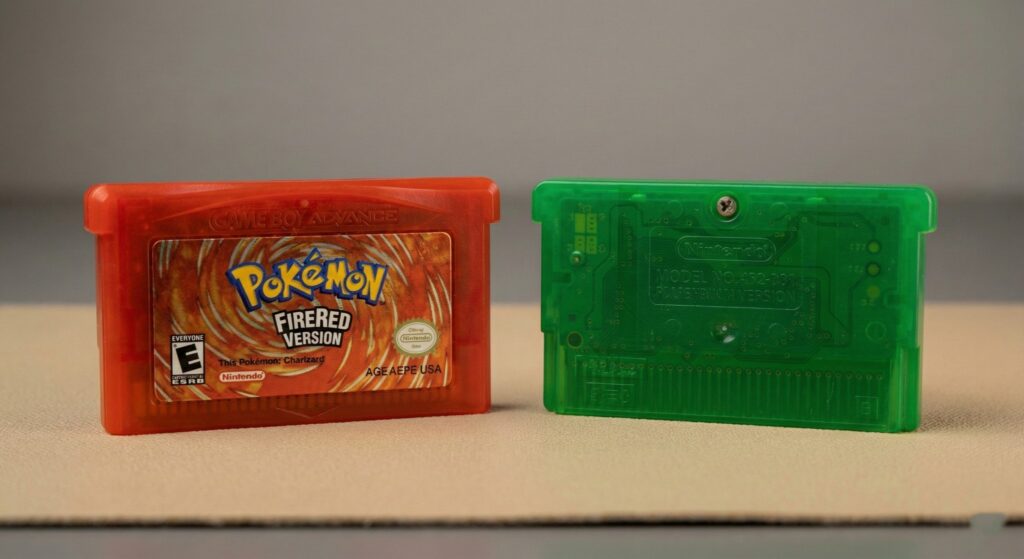
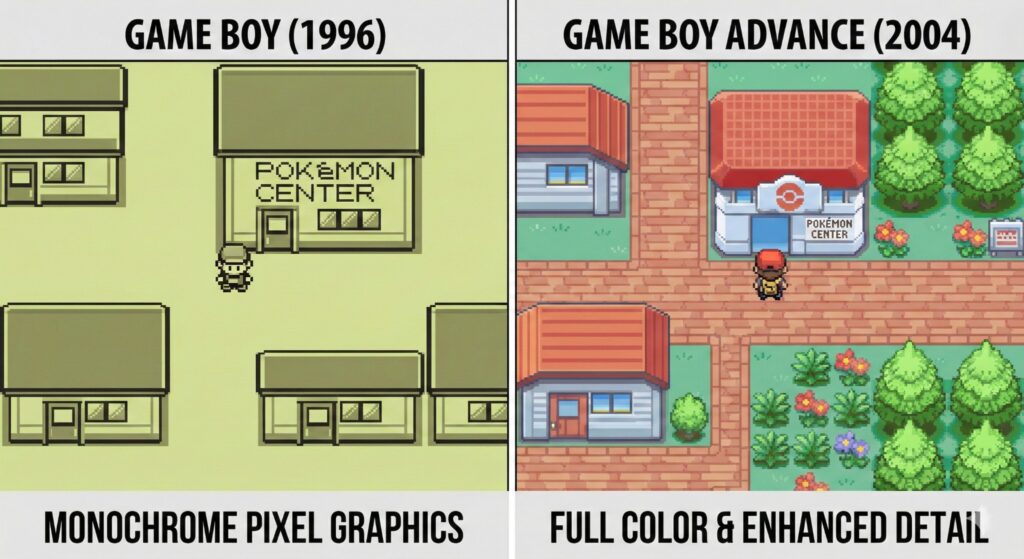
Pokémon FireRed and LeafGreen were released in 2004 for the Game Boy Advance (GBA). They are faithful remakes of the original Pokémon Red and Blue games, which launched in Japan in 1996 and in North America in 1998. Developed by Game Freak and published by Nintendo and The Pokémon Company, these remakes brought the classic Kanto region to life with updated graphics, a refreshed interface, and new features like the Sevii Islands post-game area.
The story follows the classic Pokémon journey you start in Pallet Town, pick one of three starter Pokémon (Bulbasaur, Charmander, or Squirtle), and travel across Kanto collecting Gym Badges, catching Pokémon, and ultimately challenging the Pokémon League. The final challenge of the main story is the Elite Four, located at Indigo Plateau.
What Is the Elite Four in Pokémon?
The Elite Four is a group of four extraordinarily powerful Pokémon Trainers who serve as the penultimate challenge before you face the Pokémon Champion. In every mainline Pokémon game, you must defeat all four of them consecutively without healing at a Pokémon Center between battles. If any one of your Pokémon faints, you cannot replace them until after all four battles are done (you can use items from your bag, but you cannot leave the building to access a Pokémon Center mid-run).
In FireRed and LeafGreen, the Elite Four are located at Indigo Plateau in northwestern Kanto, accessible only after you’ve collected all eight Gym Badges. Each Elite Four member specializes in a specific Pokémon type. After defeating all four, you immediately face the Pokémon Champion in this game, that’s your rival, Blue (or “Gary” as many fans know him from the anime).
What makes the Elite Four in FireRed and LeafGreen particularly challenging is the level spike. The Elite Four’s Pokémon range from the mid-50s to the low 60s, meaning if your team isn’t at least level 50–55, you’re going to struggle significantly. You’ll also want strong coverage moves across multiple types to handle all four specialists.
The Pokémon FireRed and LeafGreen Elite Four: Complete Breakdown
Let’s get into the real meat of this guide. Below is a detailed breakdown of each Elite Four member, their team, their strategies, their strongest Pokémon, and how you should approach each battle.
Lorelei Ice/Water Specialist
Type Specialty: Ice and Water
Her Team:
| Pokémon | Level | Notable Move |
|---|---|---|
| Dewgong | 54 | Ice Beam, Rest |
| Cloyster | 53 | Blizzard, Spike Cannon |
| Slowbro | 54 | Surf, Amnesia |
| Jynx | 54 | Lovely Kiss, Blizzard |
| Lapras | 56 | Ice Beam, Surf, Confuse Ray |
Lorelei is the first of the Elite Four, but don’t let that fool you into thinking she’s a pushover. Her Lapras, in particular, is a serious threat; it’s tanky, hits hard with Ice Beam and Surf, and can status you with Confuse Ray. Jynx also has Lovely Kiss, which puts your Pokémon to sleep.
Best counters: Electric-type moves destroy most of her team (Dewgong, Cloyster, Slowbro, Lapras). A strong Jolteon, Raichu, or even Magneton will tear through her lineup. Avoid using Grass, Ground, Flying, or Dragon types here, as Ice Beam will shred them.
Bruno Fighting/Rock Specialist
Type Specialty: Fighting and Rock
His Team:
| Pokémon | Level | Notable Move |
|---|---|---|
| Onix | 53 | Rock Blast, Bind |
| Hitmonchan | 55 | Fire/Ice/Thunder Punch |
| Hitmonlee | 55 | Hi Jump Kick, Mega Kick |
| Onix | 54 | Rock Blast, Bind |
| Machamp | 58 | Cross Chop, Foresight |
Bruno is arguably the easiest of the Elite Four if you’re prepared. Both Onix are weak to Water, Grass, Ground, Fighting, Ice, and Steel. Hitmonchan has elemental punches, which can surprise you if you’re not careful. Machamp is his ace and hits incredibly hard with Cross Chop.
Best counters: Psychic-type moves instantly demolish his Fighting types. A Kadabra, Alakazam, Starmie, or even Hypno will handle this battle with ease. For the Onix, any Water or Grass attack works.
Agatha Ghost/Poison Specialist
Type Specialty: Ghost and Poison
Her Team:
| Pokémon | Level | Notable Move |
|---|---|---|
| Gengar | 54 | Hypnosis, Dream Eater, Confuse Ray |
| Haunter | 53 | Hypnosis, Night Shade |
| Gengar | 58 | Hypnosis, Dream Eater, Explosion |
| Arbok | 56 | Glare, Bite, Screech |
| Haunter | 55 | Hypnosis, Confuse Ray |
Agatha is the most annoying Elite Four member by far, and many players consider her harder than Lance. Her Gengars love to put you to sleep with Hypnosis and then use Dream Eater to drain your HP while you’re snoozing. Confused Ray adds to the frustration. Her second Gengar can also use Explosion and take down your Pokémon in one hit.
Best counters: In Generation 1 mechanics (which FireRed/LeafGreen preserve), Ghost-type moves don’t hit Normal-type Pokémon. Bringing a Normal type like Snorlax or Tauros actually lets you shrug off most of her attacks. Ground-type moves also work on her Gengar. Bring Awakening items; you will need them. Psychic is resisted by Dark in this generation, but Normal-types are genuinely great here.
Pro Tip for Agatha: Stock up on Awakening and Full Heal items before this fight. Agatha’s Hypnosis has decent accuracy, and if your key sweeper falls asleep, you can lose the entire run very quickly.
Lance Dragon Specialist
Type Specialty: Dragon (and Flying)
His Team:
| Pokémon | Level | Notable Move |
|---|---|---|
| Gyarados | 56 | Hyper Beam, Surf |
| Dragonair | 54 | Surf, Blizzard, Thunder Wave |
| Dragonair | 54 | Surf, Blizzard, Thunder Wave |
| Aerodactyl | 58 | Hyper Beam, Wing Attack |
| Dragonite | 60 | Hyper Beam, Blizzard, Barrier |
Lance is the most dramatic of the Elite Four. He arrives in a cape, talks about Dragon masters, and has the highest-leveled team of the four. His ace, Dragonite at level 60, is the highest-leveled Pokémon you’ve faced so far in the game. The two Dragonair are tricky because they have Thunder Wave to paralyze you.
Best counters: Ice-type moves are the great equalizer here. Ice Beam or Blizzard will absolutely wreck every Dragon on his team. A Lapras or Articuno with Ice Beam is perfect. His Gyarados is actually Water/Flying, so Electric-type moves destroy it. His Aerodactyl is weak to Water, Electric, and Ice.
Watch out for Dragonite using Barrier, which sharply raises its Special Defense, making it harder to knock out with special attacks. Try to land a physical Ice-type hit if you have one.
Champion Blue Your Rival’s Full Team and Strategy
After defeating all four Elite Four members, you immediately enter the Champion’s chamber. There’s no healing, and Blue is waiting for you with a fully rounded team designed to counter whatever starter you picked. His team varies slightly based on your starter choice, but the general lineup looks like this:
| Pokémon | Level | Type |
|---|---|---|
| Pidgeot | 59 | Normal/Flying |
| Alakazam | 59 | Psychic |
| Rhydon | 61 | Ground/Rock |
| Gyarados / Arcanine / Exeggutor | 61 | Varies by your starter |
| Arcanine / Exeggutor / Gyarados | 63 | Varies by your starter |
| Blastoise / Venusaur / Charizard | 65 | Starter counter to yours |
Blue’s ace is always the starter that has a type advantage over yours. If you choose Bulbasaur, he’ll have Charizard. If you choose Charmander, he’ll have Blastoise. If you picked Squirtle, he’ll have Venusaur. These starters are in the mid-60s and hit extremely hard.
Key threats: Alakazam hits incredibly fast and can chunk your entire team with Psychic. Make sure you have something that can one-shot or outspeed it, a fast Pursuit user or a Dark/Ghost type. Rhydon is tanky but falls to any Water or Grass move. His starter is the final hurdle and will feel like the hardest part of the whole run.
Strategy for Blue: Going into the Champion fight with at least 5–6 healthy Pokémon and a solid stock of Revives and Hyper Potions/Full Restores is essential. If you’re low after Lance, you might want to restart the entire Elite Four run to conserve resources. Having a Pokémon that knows Earthquake is very useful against Rhydon and also helps with Blue’s various tanky Pokémon.
Best Team Composition for the Elite Four in FireRed/LeafGreen
You don’t need a “perfect” competitive team to beat the Elite Four. You just need good type coverage. Here’s a practical team structure that works incredibly well:
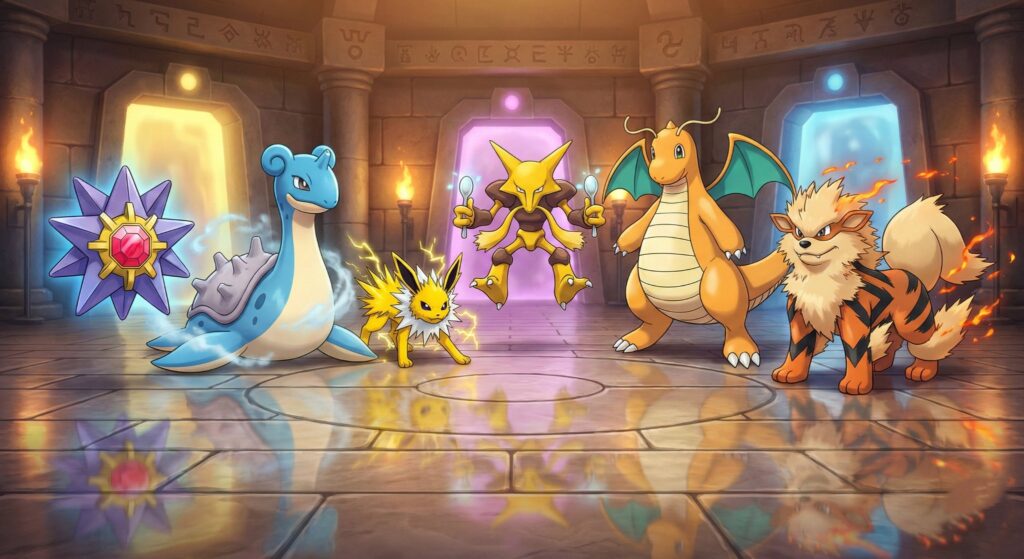
Electric-type (for Lorelei and Gyarados): Jolteon, Raichu, or Electrode. Bring Thunderbolt as the main move. This alone handles most of Lorelei’s team and chunks Gyarados and Aerodactyl from Lance.
Psychic-type (for Bruno and Agatha): Alakazam or Starmie. Psychic hits Fighting types super effectively, and Starmie doubles as a Water/Ice attacker later. Starmie is widely considered the best overall Pokémon for the Elite Four run in FireRed/LeafGreen because it covers so many threats.
Ice-type (for Lance): Lapras or Articuno if you caught it. Lapras with Ice Beam and Surf is a one-Pokémon solution to almost all of Lance’s team.
Earthquake user (for Blue’s Rhydon and general coverage): Nidoking, Nidoqueen, or even Dugtrio. Earthquake is one of the most useful moves in the game at this point.
Normal-type tank (optional but excellent against Agatha): Snorlax is perfect. High HP, resistant to Ghost moves by type immunity, and can use Earthquake and Body Slam.
Starter Pokémon: Your starter should be in the 55–60 range and rounds out your team. Charizard with Fire Blast, Blastoise with Surf/Ice Beam, or Venusaur with Razor Leaf and Sleep Powder are all solid choices.
Essential Preparation Tips Before Entering Indigo Plateau
Walking in underprepared is the number one reason players fail the Elite Four. Here’s what to do before you step through those doors.
Level grind to at least 50–55. Ideally, you want your whole team at 55 before entering. Victory Road just before the Plateau is excellent for grinding. The Pokémon there give solid EXP, and there are enough Trainers to bring you close to the right level range.
Stock up on the right items. Bring at least 15–20 Hyper Potions or Full Restores, 10 Revives or Max Revives, 5–10 Full Heals or Awakenings (for Agatha), and a decent supply of Ethers or Elixirs to restore PP on your best moves.
Make sure you have good move coverage. At minimum, you want: an Electric move, a Psychic move, an Ice move, and a Water or Ground move across your party. This covers the weak points of every Elite Four member.
Check your PP before every fight. You can use Elixirs and Ethers between battles to restore PP on moves that you’re burning through. Don’t enter Lance with only 3 PP left on Ice Beam.
The order matters strategically. The Elite Four must be battled in order: Lorelei → Bruno → Agatha → Lance → Blue. You cannot skip or rearrange them. Plan your resources accordingly, saving your strongest items for Agatha (who will frustrate you) and Lance/Blue.
Pokémon FireRed and LeafGreen Switch – Is It Available on Nintendo Switch?
This is one of the most searched questions about these games right now, and the answer is straightforward: Pokémon FireRed and LeafGreen are not available on Nintendo Switch as of 2026. They were released exclusively for the Game Boy Advance in 2004, and Nintendo has not released them on any modern platform, including the Switch or Switch Online service.
If you want to play them today, your options are a physical GBA cartridge with a Game Boy Advance or Nintendo DS/DS Lite (which has a GBA slot) or through a 3DS using a physical cartridge. Many fans have been hoping Nintendo will bring these games to Switch Online’s Game Boy library, but there has been no official announcement confirming this.
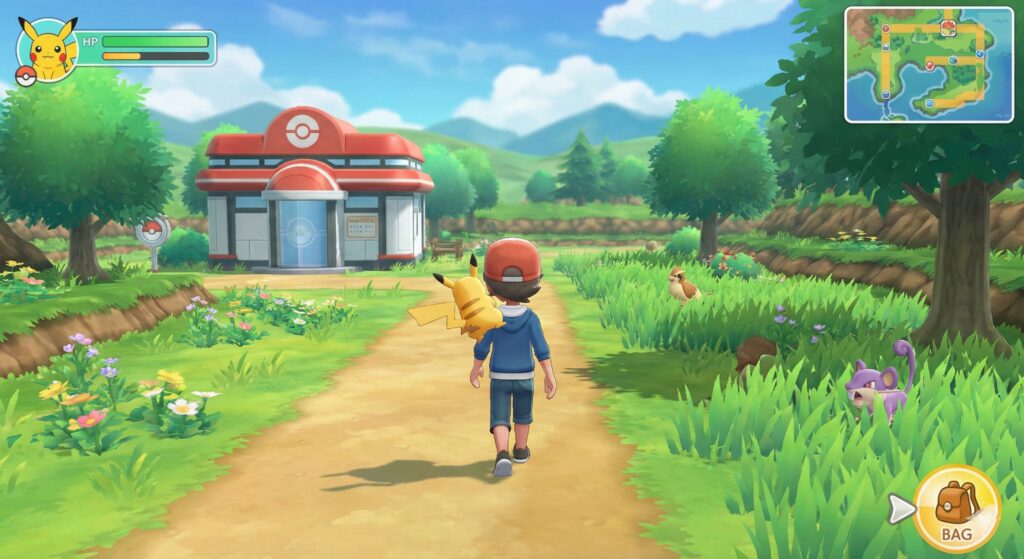
What Nintendo released on Switch is Pokémon Brilliant Diamond and Shining Pearl (remakes of Gen 4) and Pokémon Legends: Arceus. The closest experience to FireRed and LeafGreen on Switch is Pokémon: Let’s Go, Pikachu! and Let’s Go, Eevee!, which are also set in Kanto and feature the same Elite Four and Champion Blue. If you’re craving that Kanto Elite Four experience on a modern console, Let’s Go is currently your best official option.
Quick Note: Nintendo Switch Online now includes a Game Boy and Game Boy Advance library for subscribers. While FireRed and LeafGreen haven’t been added yet, it’s worth keeping an eye on Nintendo’s official announcements they regularly add classic titles to the service.
Pokémon Fire Red on Switch – What Are the Alternatives?
Since Pokémon Fire Red is not officially on Nintendo Switch, a lot of players are looking for the next best thing. Here’s an honest breakdown of your options if you want that classic Kanto experience on a Switch.
Pokémon: Let’s Go, Pikachu! and Let’s Go, Eevee! are the closest official experiences. These games are set in Kanto, follow the same story as FireRed and LeafGreen, and feature the same Elite Four Lorelei, Bruno, Agatha, and Lance with Champion Blue at the end. The gameplay is modernized with motion controls and a Pokémon Go-style catching mechanic, but the core story and world are faithful to the originals.
If you’re a purist and want the exact FireRed experience, the most legitimate route is to buy an original GBA cartridge. Authentic copies are still widely available through second-hand marketplaces. Just make sure you’re buying a genuine cartridge and not a cheap reproduction. There are many fakes on the market, so always check seller reviews carefully.
For players who want the Elite Four challenge specifically, the Let’s Go games actually offer an interesting twist: the Elite Four’s Pokémon are stronger and more varied than in FireRed, making it a fresh challenge even for veterans of the original games.
What Pokémon Are in Fire Red That Are Not in Leaf Green?
Like all paired Pokémon games, FireRed and LeafGreen have version-exclusive Pokémon, meaning some Pokémon can only be caught in one version and not the other. This was designed to encourage trading between players. Here’s a clear breakdown of the key exclusives:
| Pokémon FireRed Exclusives | Pokémon LeafGreen Exclusives |
|---|---|
| Ekans / Arbok | Sandshrew / Sandslash |
| Oddish / Gloom / Vileplume | Bellsprout / Weepinbell / Victreebel |
| Psyduck / Golduck | Slowpoke / Slowbro |
| Growlithe / Arcanine | Vulpix / Ninetales |
| Shellder / Cloyster | Staryu / Starmie |
| Electabuzz | Magmar |
| Scyther | Pinsir |
| Magmar (post-game) | Electabuzz (post-game) |
A few important notes here. Starmie, which we recommended earlier as one of the best Elite Four Pokémon, is a LeafGreen exclusive. If you’re playing FireRed and want a Starmie, you’ll need to trade one over from LeafGreen. Similarly, Arcanine is FireRed-exclusive and is a great Pokémon for the Elite Four run in that version.
This version exclusivity is worth knowing before you commit to your Elite Four team, because it affects which Pokémon you can realistically access without trading. If you’re playing FireRed solo, lean toward Jolteon for Electric coverage (since you can’t get Starmie without trading) and Arcanine as a strong physical attacker.
The Sevii Islands post-game area also introduces additional version-exclusive encounters, but those come after the Elite Four, so they won’t affect your first run through the league.
Is Fire Red a Remake?
Yes, Pokémon FireRed is officially a remake. Specifically, it is a remake of the original Pokémon Red, which was one of the two launch titles for the Pokémon franchise in Japan in 1996 (alongside Pokémon Green, which became Pokémon Blue internationally). LeafGreen is the paired remake of Pokémon Blue (known as Green in Japan).
Game Freak developed FireRed and LeafGreen and released them in January 2004 in Japan and September 2004 in North America for the Game Boy Advance. The remakes were built from the ground up with updated graphics suited to the GBA hardware, an overhauled UI, a proper tutorial system (the originals dropped you in with very little guidance), and the inclusion of the Physical/Special split mechanics from later games though this was still the Gen 3 engine, so the true Physical/Special split didn’t arrive until Gen 4.
The remakes also added entirely new content that wasn’t in the originals, most notably the Sevii Islands, a post-game archipelago with new areas, new Pokémon to catch (including Gen 2 Pokémon not available in the main game), and additional story content involving the Pokémon Network Center and Team Rocket.
So, to directly answer the question: FireRed is not just a port or a remaster, it is a full remake with new content, updated mechanics, and a redesigned experience built for the GBA generation of players. Many fans consider it the definitive way to experience the original Kanto story, at least until Pokémon: Let’s Go brought it to modern hardware.
Can You Rematch the Elite Four in FireRed and LeafGreen?
Yes! After you become Champion and complete the initial post-game content on the Sevii Islands, you can return to Indigo Plateau and re-challenge the Elite Four as many times as you want. The great news is that their teams are the same on rematches; they don’t level up in FireRed and LeafGreen the way they do in later games like HeartGold and SoulSilver. However, the rematches are still a solid source of EXP and money for leveling up newly caught Pokémon.
Rematching is also a great strategy if you want to level up a Pokémon you caught post-game, or if you’re doing a challenge run (like a Nuzlocke) and want to test yourself again.
Final Thoughts on the Pokémon FireRed and LeafGreen Elite Four
The Pokémon FireRed and LeafGreen Elite Four is a rite of passage for anyone who grew up with Pokémon. It’s challenging without being unfair, dramatic without being over-the-top, and rewarding in a way that few other moments in gaming match. That moment when you finally see the credits roll and your rival acknowledges your strength, it’s genuinely special, even twenty years later.
The key takeaways: level your team to at least 55, bring wide-type coverage (especially Electric, Ice, and Psychic moves), stock up on Revives and Full Heals before Agatha, and save enough resources to handle Blue after the four main fights. Starmie and Lapras are your best friends in this entire run.
Whether you’re going for a clean first-time clear or you’re on your fifth playthrough trying to solo the Elite Four with just your starter, FireRed and LeafGreen remain some of the most replayable and satisfying Pokémon games ever made. Now get out there, take on Indigo Plateau, and become the Pokémon Champion.
What level should my Pokémon be for the Elite Four in FireRed and LeafGreen?
Ideally, you want your entire party at level 50 minimum, with your main battlers closer to level 55–60. Lance’s Dragonite is level 60, and Blue’s starter is level 65, so the closer your team is to that range, the better. The good news is that if you’ve been training throughout the game and battled most of the Trainers you came across, you should be in the right range after clearing Victory Road
What is the hardest Elite Four member in FireRed and LeafGreen?
Most experienced players agree that Agatha is the most annoying, while Lance is the most threatening in terms of raw power. Agatha’s constant sleep and confusion status moves can end your run if you’re unlucky, while Lance’s Dragonite with Hyper Beam and Blizzard hits like a freight train. New players often struggle most with Agatha; experienced players fear Lance.
What is the best starter Pokémon for the Elite Four?
All three starters are viable, but Blastoise gets the edge for the Elite Four run. Surf and Ice Beam give it excellent coverage against Lorelei (partially), Bruno’s Onix, Lance’s dragons, and several of Blue’s Pokémon. Charizard struggles a bit because Lorelei’s Ice moves hit it for super effective damage (4x against Flying/Fire). Venusaur is great against Bruno and Blue’s Blastoise specifically.
Can you heal between Elite Four battles in FireRed and LeafGreen?
You cannot leave Indigo Plateau to visit a Pokémon Center between battles. However, you CAN use items from your bag during and between battles. This means Revives, Potions, and Full Heals are perfectly legal and very much encouraged. The game does not restrict item use during the Elite Four; this is not a “no items” challenge unless you set that rule yourself. Between battles (in the hallways between rooms), you can freely use healing items before stepping into the next fight.
Does the Elite Four team change in FireRed and LeafGreen compared to the originals?
Very slightly. The teams are almost identical to the original Red and Blue games, with only minor adjustments to levels and occasional move changes. The biggest difference is that in FireRed and LeafGreen, the game mechanics are Gen 3, which means moves like Earthquake and Psychic work slightly differently than in Gen 1. Ghost types now correctly work against Psychic types (in Gen 1, Ghost did not affect Psychic due to a well-known glitch), so don’t try the old Gen 1 Ghost trick here.
Is Mewtwo useful in the Elite Four?
Absolutely, but you can’t catch Mewtwo until after you’ve already beaten the Elite Four and become Champion. Mewtwo is found in Cerulean Cave, which only becomes accessible post-game. So while Mewtwo is an incredible Pokémon that will demolish the Elite Four on rematches, it won’t help you for your first run.
What is the best single Pokémon to bring to the Elite Four?
Starmie is widely considered the single best Pokémon for the Elite Four run in FireRed and LeafGreen. With Surf and Ice Beam, it handles Lorelei’s team, destroys Bruno’s Onix with Surf, can deal with Lance’s Dragons using Ice Beam, and covers a large portion of Blue’s team, too. It’s also fast, meaning it goes first against most opponents. If you had to pick just one Pokémon to carry the run, Starmie with Surf/Ice Beam/Thunderbolt/Psychic is the answer.